










What REALTOR® Members Need to Know Before March 1, 2026
A new federal reporting requirement is about to enter the residential real estate space. Beginning March 1, 2026, certain non-financed residential transactions must be reported to the U.S. Department of the Treasury’s Financial Crimes Enforcement Network, also known as FinCEN.
This rule applies to closings that occur on or after March 1, 2026. Transactions closing before that date are not affected.
Download the GAAR's FinCEN Information Sheet here.
Here is what matters most for you.
What Is the Rule?
The Residential Real Estate Rule requires a Real Estate Report to be filed with FinCEN for certain residential property transfers involving:
- Non-financed transactions, and
- Buyers that are legal entities or trusts
FinCEN’s official resource page is available at: https://www.fincen.gov/rre
The goal is increased transparency in residential transactions to combat money laundering.
When Is a Transfer Reportable?
A transfer is reportable only when all four conditions are met :
- The property is residential real property
- The transfer is non-financed
- The buyer is a legal entity or trust
- No exception applies
If even one of those conditions is missing, the report is not required.
What counts as residential real property?
Residential real property includes :
- 1–4 family homes
- Condominiums and townhomes
- Cooperative units
- Land intended for 1–4 family construction
What is a non-financed transfer?
A non-financed transfer does not involve credit secured by the property and extended by a financial institution, subject to AML and SAR requirements.
In plain terms, this will most often mean:
- All-cash purchases
- Certain private or unconventional financing arrangements
Traditional financed purchases through banks and regulated lenders will generally not be affected.
Important Exceptions
Not every entity or trust purchase is reportable. There are specific exceptions.
Examples of transfers that are not reportable include:
- Transfers resulting from death
- Divorce-related transfers
- Bankruptcy transfers
- Court-supervised transfers
- Certain 1031 exchanges
- Easements
Certain regulated entities are also exempt, including banks, credit unions, governmental authorities, insurance companies, registered investment companies, and others.
This is a targeted rule. Most traditional residential deals will not trigger reporting.
Who Files the Report?
In most cases, the closing or settlement agent will be the “reporting person”.
FinCEN created a “reporting cascade” to determine who must file if multiple professionals are involved. Only one person in the transaction is responsible for filing.
A written designation agreement may also assign reporting responsibility to another qualified party.
As a broker, you are not automatically the reporting person, but you should be aware when your transaction may fall into this category so you can coordinate with title and settlement providers.
NMAR Purchase Agreement Update
To help ensure transparency and smooth transactions, the New Mexico Association of REALTORS® (NMAR) has added language to the Purchase Agreement to inform buyers of this new federal reporting requirement.
This added disclosure alerts buyers that certain non-financed transactions involving entities or trusts may trigger a Real Estate Report to be filed with FinCEN, effective March 1, 2026. Including this language up front helps set expectations early and reduces surprises at closing.
As a broker, be sure you are using the most current version of the Purchase Agreement and understand how this disclosure may apply to your transactions.
What Information Is Collected?
The Real Estate Report includes information about:
- The reporting person
- The property
- The transferor (seller)
- The buyer entity or trust
- Beneficial owners of the entity or trust
- Total purchase price
- How the transaction was funded
The form itself requires detailed identifying information, including legal names, addresses, dates of birth for beneficial owners, identification numbers, and payment details.
FinCEN states that reports are filed securely and are not accessible to the general public.
Filing Deadline
The Real Estate Report must be filed by the later of :
- The last day of the month following the month of closing, or
- 30 calendar days after closing
In practice, reporting persons will generally have about 30–60 days after closing to file.
What This Means for Brokers
Even if you are not filing the report, you should:
- Flag transactions involving entity or trust buyers
- Confirm whether the deal is non-financed
- Prepare clients for potential additional information requests
- Expect possible administrative adjustments early in implementation
There may be minor delays at first as settlement providers adapt. Education and early coordination will be key.
Bottom Line
This rule targets a narrow category of transactions, primarily all-cash purchases by entities or trusts. Most traditionally financed residential transactions will not be impacted.
The key date is March 1, 2026.
For full guidance, FAQs, and filing resources, visit: https://www.fincen.gov/rre
If you have questions about how this may affect your upcoming transactions, now is the time to start the conversation with your title and settlement partners. Early awareness beats last-minute surprises every time.
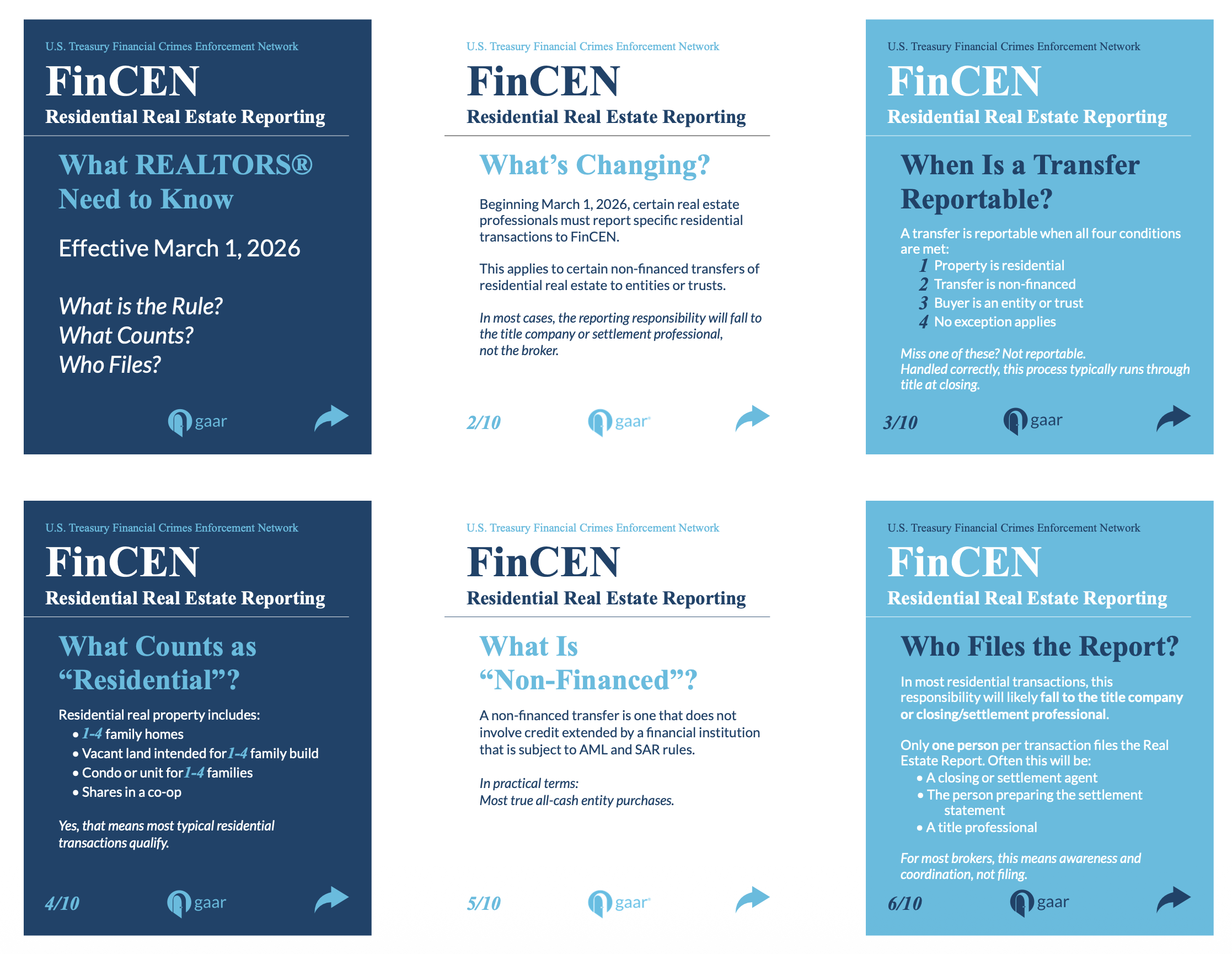
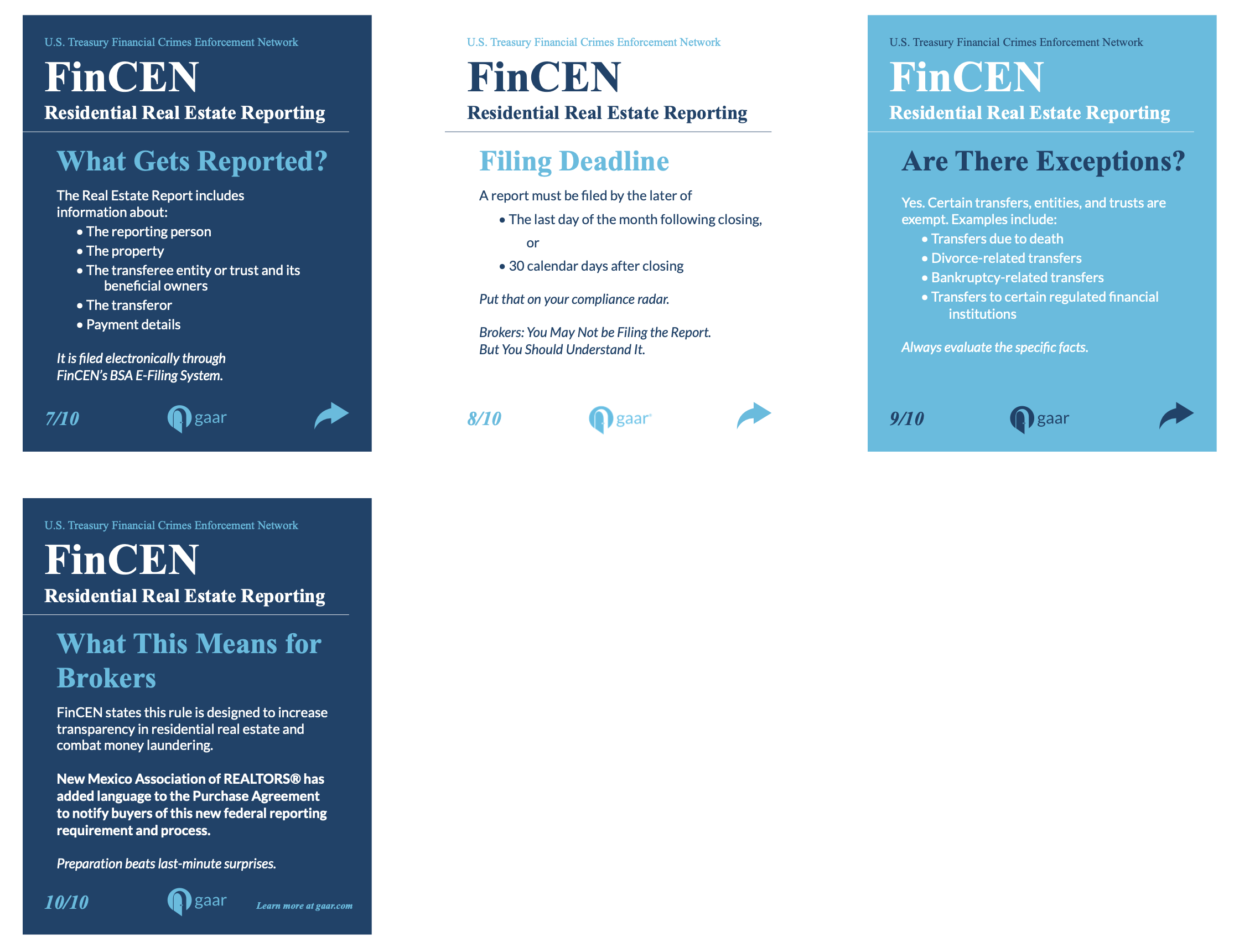
Download the PDF of these infographics by clicking the image below. These are also shareable through GAAR's social media!



Comments