











Housing affordability is not just a question of how many homes are being built. It is also about whether existing homeowners can afford to move.
The National Association of REALTORS® (NAR) is advocating for an update to the federal capital gains tax exclusion on the sale of a primary residence, a policy that has remained unchanged since 1997 despite dramatic increases in home values. NAR argues that modernizing the exclusion could encourage more longtime homeowners to sell, increase housing inventory and create more opportunities for buyers. (National Association of Realtors)
A Tax Threshold Frozen in 1997
Under current federal law, qualifying homeowners can exclude up to $250,000 in capital gains for individual filers and $500,000 for married couples filing jointly when selling a primary residence. Those limits were established in 1997 and were not indexed for inflation. (National Association of Realtors)
A lot has changed since then.
In 1997, the median existing single-family home price was approximately $129,000. Today, NAR's 2025-26 figure is $419,300, an increase of 225%.
As homeowners build equity over decades, more are reaching a point where selling could result in gains that exceed the exclusion. NAR estimates that more than 13 million homeowners would exceed today's capital gains exclusion if they sold their primary residence.
For some longtime homeowners, particularly seniors considering downsizing, that potential tax consequence can become another reason to stay put. When fewer owners sell, fewer homes become available for the next buyer.
The Ripple Effect on Housing
This does not only affect homeowners with significant equity. Limited movement within the housing market can create a chain reaction.
A senior who decides to downsize may put a larger home back on the market for a growing family. That family may sell its starter home, opening an opportunity for a first-time buyer. When one of those moves does not happen, opportunities further down the line can disappear too.
NAR's one-pager identifies several groups affected by today's policy: first-time buyers facing limited options, growing families searching for homes that better fit their needs, seniors who may be discouraged from downsizing, and local economies that benefit from the activity generated by home sales.
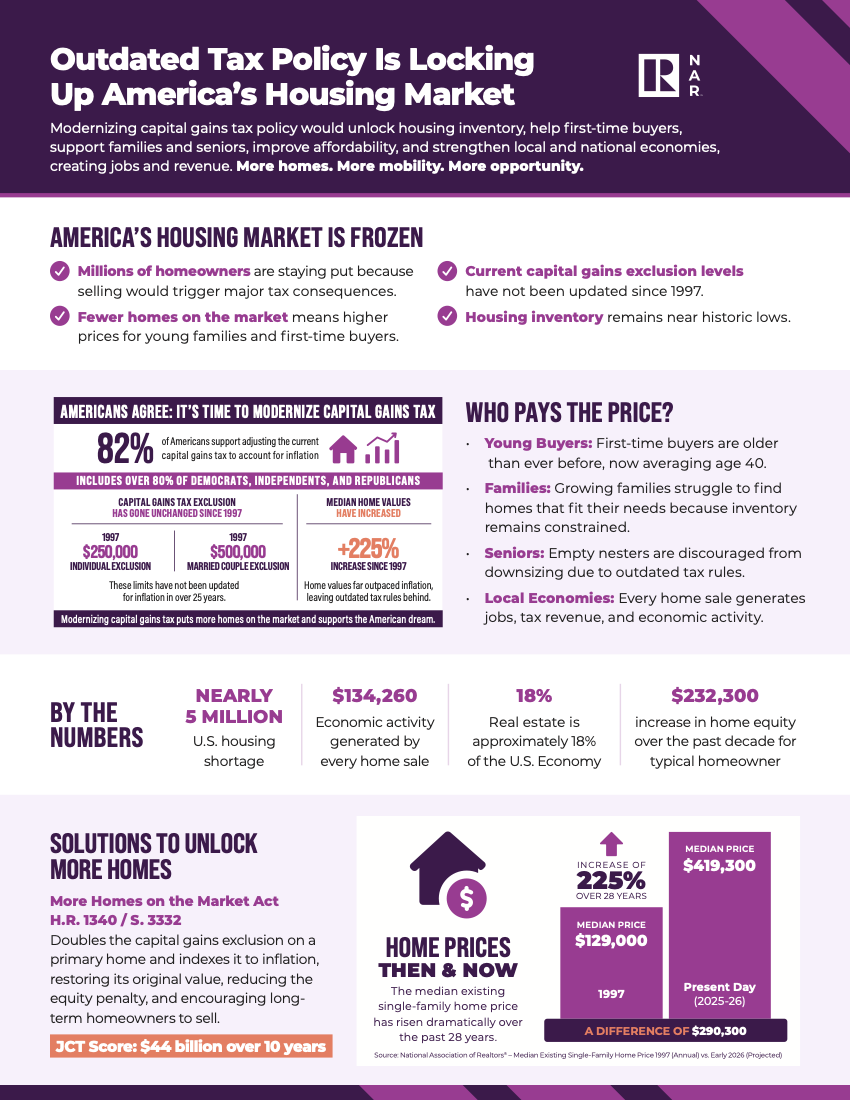
The inventory challenge is substantial. NAR cites a U.S. housing shortage of nearly 5 million homes, while estimating that each home sale generates approximately $134,260 in economic activity.
A Proposal to Modernize the Exclusion
One proposal supported by NAR is the bipartisan More Homes on the Market Act, H.R. 1340 / S. 3332. The legislation would double the capital gains exclusion on the sale of a primary residence and index it for future inflation.
NAR's policy position calls for the current $250,000 and $500,000 exclusion amounts to be significantly increased and indexed for inflation so the benefit does not continue to erode as home prices rise.
There is also broad public support for updating the policy. According to polling cited by NAR, 82% of Americans support adjusting the current capital gains tax exclusion to account for inflation, including more than 80% of Democrats, Independents and Republicans.
More Homes. More Mobility. More Opportunity.
Modernizing the capital gains exclusion is ultimately about allowing the housing market to move more freely. Encouraging longtime homeowners who want to sell or downsize could put additional homes on the market, create opportunities for families and first-time buyers, and generate economic activity in communities across the country.
For REALTORS®, the issue also illustrates how federal tax policy can have a direct effect on local housing inventory, affordability and homeowner mobility.
Learn more about NAR's capital gains advocacy, research and resources through the NAR Home Equity Tax resource page.


Comments