











Existing-home sales rose slightly last month, as lower mortgage rates and slower price increases help better position buyers this spring. Read more from NAR’s latest housing report.
Climbing out of a gloomy winter, existing-home sales reversed course following a sharp drop in January and ticked up slightly in February as housing affordability improved nationwide, the National Association of REALTORS® reported Tuesday. Lower mortgage rates, rising wages and slower price growth are offering improving conditions for prospective home buyers. First-time buyers also made a modest return to the market last month.
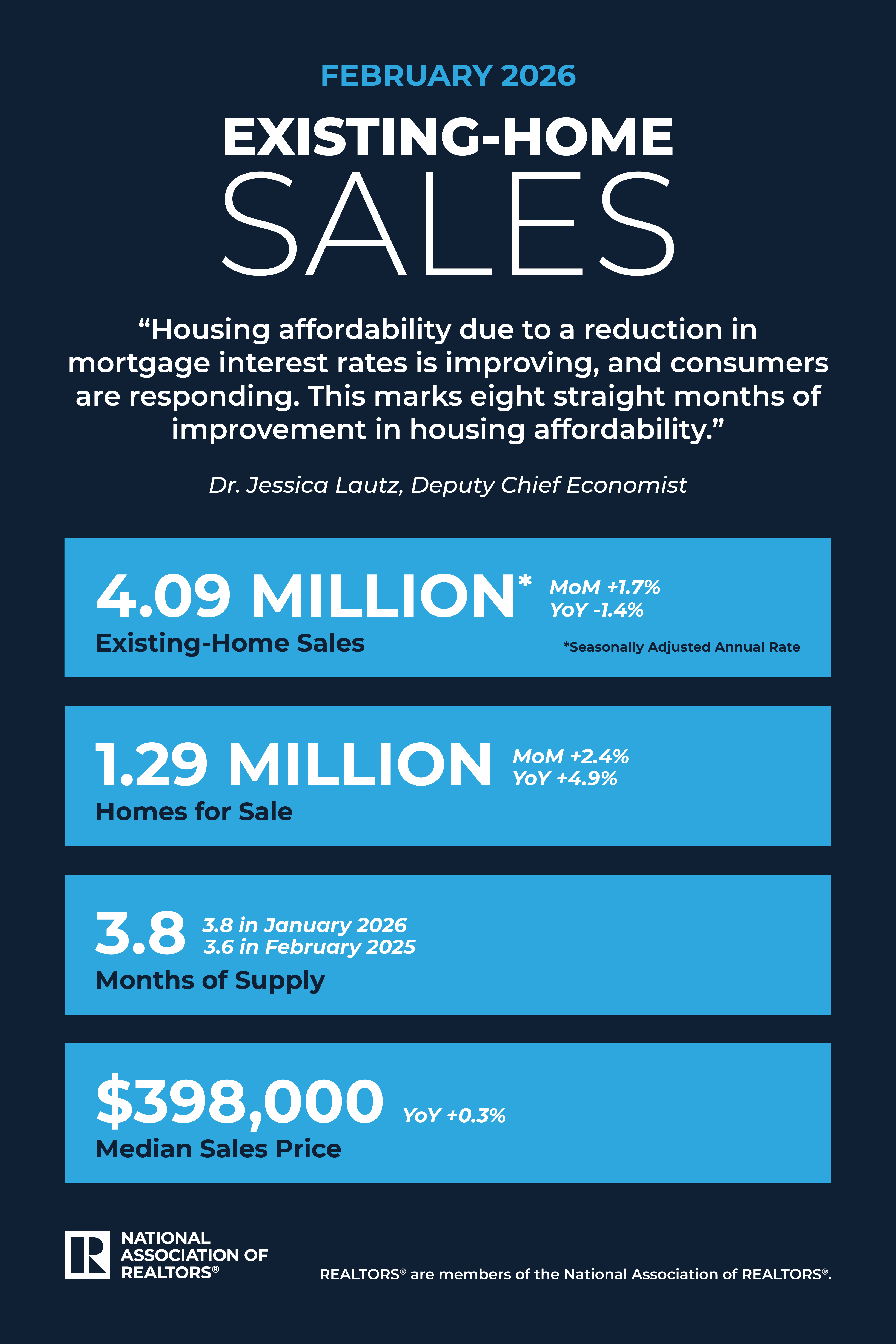
Existing-home sales—including single-family homes, townhomes, condos and co-ops—increased 1.7% month-over-month in February. Still, sales remain down by 1.4% when compared to a year ago, NAR reports.
But the latest housing numbers do offer a hopeful sign heading into spring: “Housing affordability is improving, and consumers are responding,” says Lawrence Yun, NAR’s chief economist.
Mortgage rates alone are making a meaningful difference: The drop from about 7% at the start of 2025 to around 6% today could put roughly $2,000 per year back into a buyer’s pocket through lower monthly payments.
Lower rates also are expanding the eligible pool of buyers. NAR data shows that the 1% decline in mortgage rates means an additional 5.5 million households can now qualify for a mortgage—including 1.6 million renters who could potentially become first-time buyers.
Prospective buyers may be gradually getting that message: First-time buyers comprised 34% of existing-home sales in February, up from 31% a year ago, NAR’s data shows.
Positives and Challenges Remain for the Housing Market
Despite last month’s increase, the housing market still has a long way in returning to pre-pandemic levels of transaction sales activity, Yun notes. “There are more than 6 million more jobs than in 2019, yet home sales per year are down by one million,” Yun says, adding that housing demand remains “muted relative to wage growth and job growth.”
Still, several factors are improving for home buyers. Wage growth is outpacing home price growth by nearly 4 percentage points, Yun notes. Thirty-year fixed-rate mortgages—which averaged 6.84% a year ago—averaged 6.05% in February and have fallen further since with rates averaging 6% last week.
The number of for-sale signs is gradually increasing as well, with housing inventories up 2.4% from January and about 5% from a year ago. “If [buyer] demand picks up notably in the coming months and outpaces supply growth, home prices will inevitably rise,” Yun says. “That is why increasing supply is so important to help limit home price growth, improve housing affordability and boost transactions.”
For now, home prices are moderating. The median existing-home price was $398,000 in February, up just 0.3% from a year earlier, NAR reports. The median price for single-family homes rose just 0.2% year-over-year to $401,800, while the median price for condos and co-ops increased 0.9% to $358,100 nationwide.
Lower prices may attract buyers: The West saw existing-home sales climb 8.2% last month, as home prices moderated from a year ago, and affordability in the region saw the biggest improvement nationwide. Indeed, NAR’s Housing Affordability Index has shown notable improvement across the country with affordability rising across all regions:
- Northeast: up 10%
- Midwest: up 11.7%
- South: up 14.1%
- West: up 17%
Related: Measuring Housing Affordability: Is That Home Really Affordable?
Buyers May Be in a Better Negotiating Spot
While home prices remain strong in most markets, some sellers are making price adjustments to win more buyer attention this winter. Fewer homes are selling above list price than a year ago. About 14% of homes sold above asking price in February, down from 21% a year ago, NAR’s report shows.
Buyers also may find they have more time to decide: The median time a home spent on the market was 47 days in February, up from 42 days a year ago, according to the February 2026 REALTORS® Confidence Index report.
Still, competition remains. All-cash home buyers—including investors, second home buyers or equity-rich homeowners—accounted for 31% of existing-home sales transactions last month. That is up from 27% in January.
Meanwhile, distressed sales remain a small share of the market. Foreclosures and short sales comprised 3% of sales in February, up slightly from 2% in January but unchanged from a year ago.
Regional Snapshot
Here’s a closer look at existing-home sales in February from across the country:
- Northeast: Sales fell 6% last month compared to January, reaching an annual rate of 470,000. Sales were down 4.1% from a year ago. Median price: $479,800, up 3.3% from a year ago.
- Midwest: Sales increased 1.1% month-over-month to an annual rate of 940,000. Sales were down 4.1% from last year. Median price: $302,100, up 2.3% from a year ago.
- South: Sales rose 1.6% in February compared to January, settling in at an annual rate of 1.89 million. Sales are up slightly by 0.5% from a year ago. Median price: $356,800, up 0.2% from a year ago.
- West: Existing-home sales surged 8.2% in February compared to January, reaching an annual rate of 790,000. Sales are down 1.3% from a year ago. Median price: $603,100, down 1.9% from a year ago.
Source: Melissa Dittmann Tracy for NAR REALTOR® News

Comments