










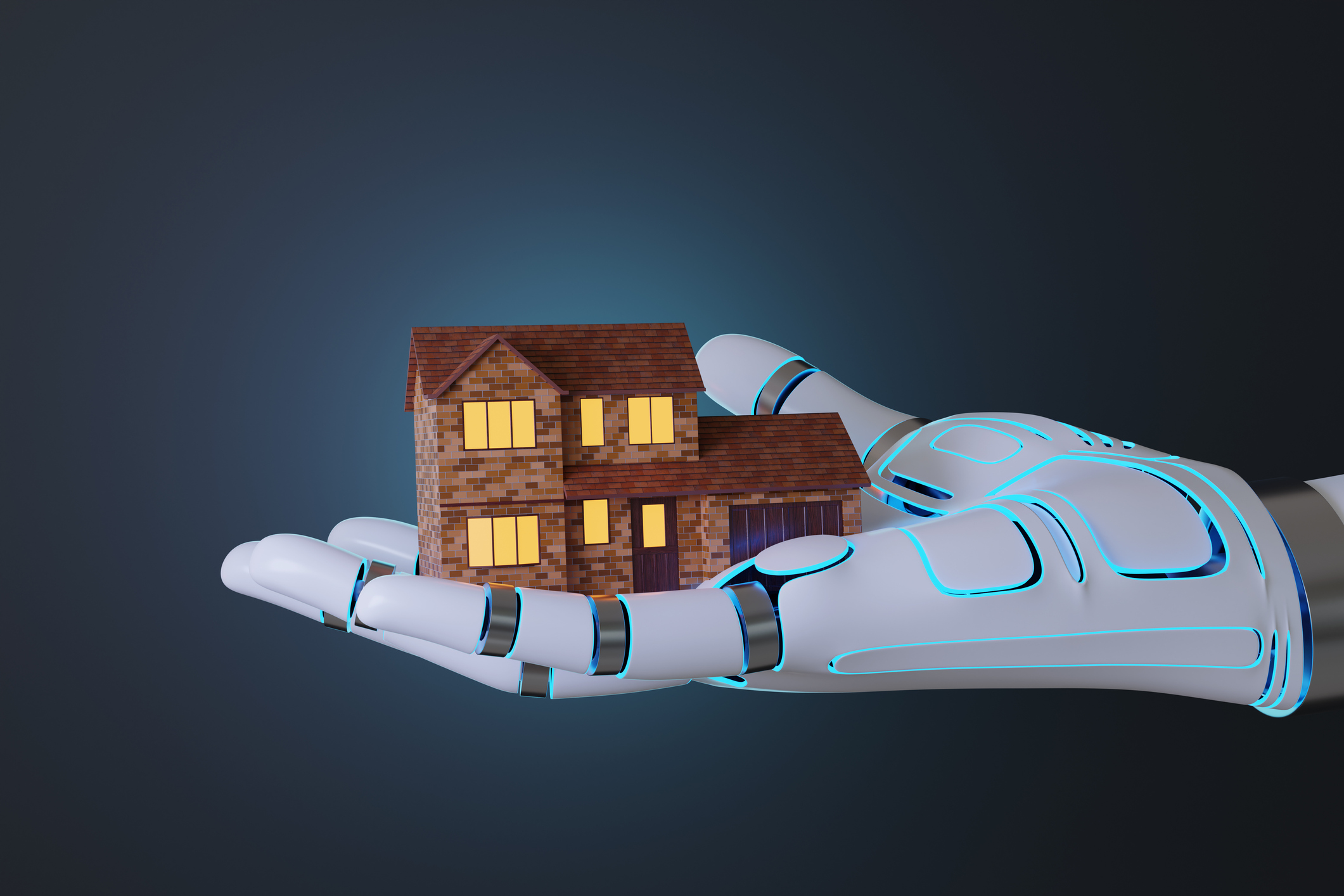
The one word that best describes artificial intelligence (AI): Transformative. Certainly, AI has done plenty of transforming since it went mainstream with generative AI in 2022. But that was just the beginning. AI is poised to make another huge transformative leap with “physical AI”—essentially AI that understands the world through sensors.
The current concept of physical AI is synonymous with robots. That’s largely because physical AI systems are getting embodied in physical machines such as robots, drones and autonomous vehicles.
The systems largely already in use are focused on automation, but the next evolution—and what could be the most transformative—is augmentation. These will be AI systems that better connect the digital and physical worlds, multiplying human capacity. One area where physical AI could have tremendous impact is in the construction space, and real estate professionals who understand physical AI stand to benefit the most from it.
What Is Physical AI?
By now, most of us are familiar with common AI tools—such as generative AI like ChatGPT—that operate exclusively in digital environments. Physical AI is bringing AI-powered robotic systems that can autonomously understand, perceive, reason and interact with the physical world in real time. Intelligent algorithms power robotic machines and systems that use sensory input, spatial recognition and understanding, and decision-making capabilities to respond and adapt to real-world environments and the physical characteristics within them.
While traditional robotic systems follow instructions that are programmed into the systems, physical AI systems use sensors and volumes of data to understand and perceive their environments. Therefore, these processing units learn from experiences and adapt to real-time data. Mechanical hardware—or actuators—can execute tasks in dynamic 3D environments. Physical AI systems can navigate changing and unpredictable spaces, interact with objects around them and make decisions almost instantly to adapt to their surroundings and complete tasks.
Physical AI is finding a home in new-home construction. Guy German, chief executive officer of Okibo, a company that produces autonomous wall painting and drywall finishing robots, understands that though these systems can be used efficiently and effectively to automate repetitive tasks. But their real transformative power lies in their abilities to perceive, reason and adapt by bringing intelligence algorithms into physical environments. “While the physical form of our robots is purpose-built and far more suitable than humanoids for construction tasks, the underlying autonomy stack relies heavily on spatial and physical AI,” German says. “This includes 3D perception, localization, motion planning and force-aware control for mobile manipulation. We are solving these tasks with industrial-grade accuracy and efficiency, not by imitating human behavior, but by implementing workflows that are fundamentally more efficient.”
How Physical AI in Construction Benefits the Real Estate Industry
Physical AI in robotic technologies for new construction is not yet ready for widespread adoption, especially in the form of humanoid machines. Now is the time to learn about and explore its potential. Doing so can help you understand what’s coming and how it can benefit your business.
Physical AI can help the real estate industry tackle challenges such as affordability and chronic low inventory, which have become impediments to many real estate businesses. Adding physical AI to construction technology offers solutions to these issues by potentially speeding up new-construction timelines, despite the current labor shortages, as well as being able to build more affordable homes for buyers.
One great example is Zuri Gardens, a Houston area development of 80 hybrid 3D-printed homes that uses robotic technology in the construction process. This development is using cutting edge 3D printing and robot technologies to create one of the country’s largest 3D-printed housing developments. According to Cole Klein Builders and HiveAsmbld, a robotic arm is being used to build the first levels of all homes. Human construction workers then frame and finish the homes using traditional building methods. The result will be 80 new homes priced in the mid-to-high $200,000 range built in about 18 months.
The construction industry has been exploring ways to transform processes with the help of AI-driven excavators, bulldozers and cranes that can be operated autonomously or with human direction for digging, leveling and placing materials. Smarter heavy machinery is already in place on job sites worldwide. AI-enabled robotic systems built for this purpose are already installing drywall, laying bricks and finishing concrete with precision. In fact, one report projects that as many as 1.3 billion AI-powered robots will be working worldwide by 2035.
But won’t this growth in AI robots replace human construction jobs? “In practice, we often see the opposite,” says German. “Field teams are happy to adopt the technology because it makes their work easier and safer. Once crews experience the system firsthand, adoption tends to accelerate.”
Instead, physical AI offers solutions to the construction industry’s most pressing problems, like the critical labor shortages, growing global demand for more housing and infrastructure, and the need to replace or reimagine aging assets. Increasingly, conversations around robotics in any vertical, including new construction, are about how these systems work with humans to improve processes, safety, sustainability and outcomes rather than how they replace humans.
The Physical AI-Powered Humanoids Are Coming
Beyond automation, the next big thing we’ll see in physical AI and robotics is the arrival of general-purpose humanoid robots that can take on diverse, unrelated tasks in multiple settings. In the new construction space, their arrival might be several years away, but the surge of investment into physical AI systems and rapid technological advances could accelerate that timeline. According to McKinsey and Company, funding for robotic systems—including humanoids—“grew fivefold” from 2022 to 2024 and now surpasses $1 billion annually. Real estate professionals should be preparing for partnerships with construction companies that adopt technology and create work sites where autonomous systems are used to support workers and deliver efficiencies for managing multiple projects. Offloading some tasks can free humans for high-level decision-making and completing projects more quickly in catering to potential buyers.
At this point, the main obstacle to deploying humanoids in new construction is that they are not yet fully capable of navigating busy, unstructured job sites. With every project having a differing landscape—and with constantly changing layouts, equipment, materials and workers in motion—perfecting humanoids’ abilities to perceive, react and adapt safety takes time.
Humans rely on experience, observation, direction from others and external information such as maps to move around. Humanoids rely on extensive and sophisticated data gathering about their surroundings via sensors and other contextual data. However, as humanoids’ data gathering capabilities, processing and mobility evolves, their value in the construction and real estate domains will accelerate. For example, when humanoids can climb ladders or scaffolding, walk on uneven surfaces and execute more dexterous tasks, like operating small tools, everything will change. Humanoids will be able to support human construction workers in new ways.
The Future With Physical AI
These intelligent tools will become invaluable to humans and workplaces. The value robots bring will likely be most impactful in four key areas for the construction industry:
- Speed up timelines: Robotic systems will accelerate the rate at which new construction can be completed, increasing the housing supply and stabilizing prices.
- Lower costs: They’ll help to reduce labor costs and minimize rework, which lowers costs per unit and increases affordability.
- Increase efficiencies: Long-term sustainability is enhanced as robots increase human capacity and create opportunities to upskill workers rather than replace them.
- Add safety: Autonomous systems in construction reduce time humans spend on hazardous tasks: Human requirements of heavy lifting, navigating high heights and repetitive overhead motion on a construction site can be reduced by about 25-100% in most cases, according to a BuildOps case study. This improves worker safety and reduces downtime.
Physical AI will fuel industries like construction and real estate by using intelligent algorithms to execute real-world actions and provide enhanced, collaborative robotic tools that can help solve industry challenges. Physical AI’s real value isn’t in automating, but rather in augmenting humans’ capacities to do more with smaller, smarter teams within increasingly complex environments.
Source: Sharon Love-Bates for NAR Tech & Innovation.



Comments